Idle Tycoon · Prohibition

Clean Money

A laundromat out front. A smuggling ring out back. How hot do you let it run before the cops show up?

Free · no commitment · Play auto-installs it at launch

Free Android · Google Play
The hook

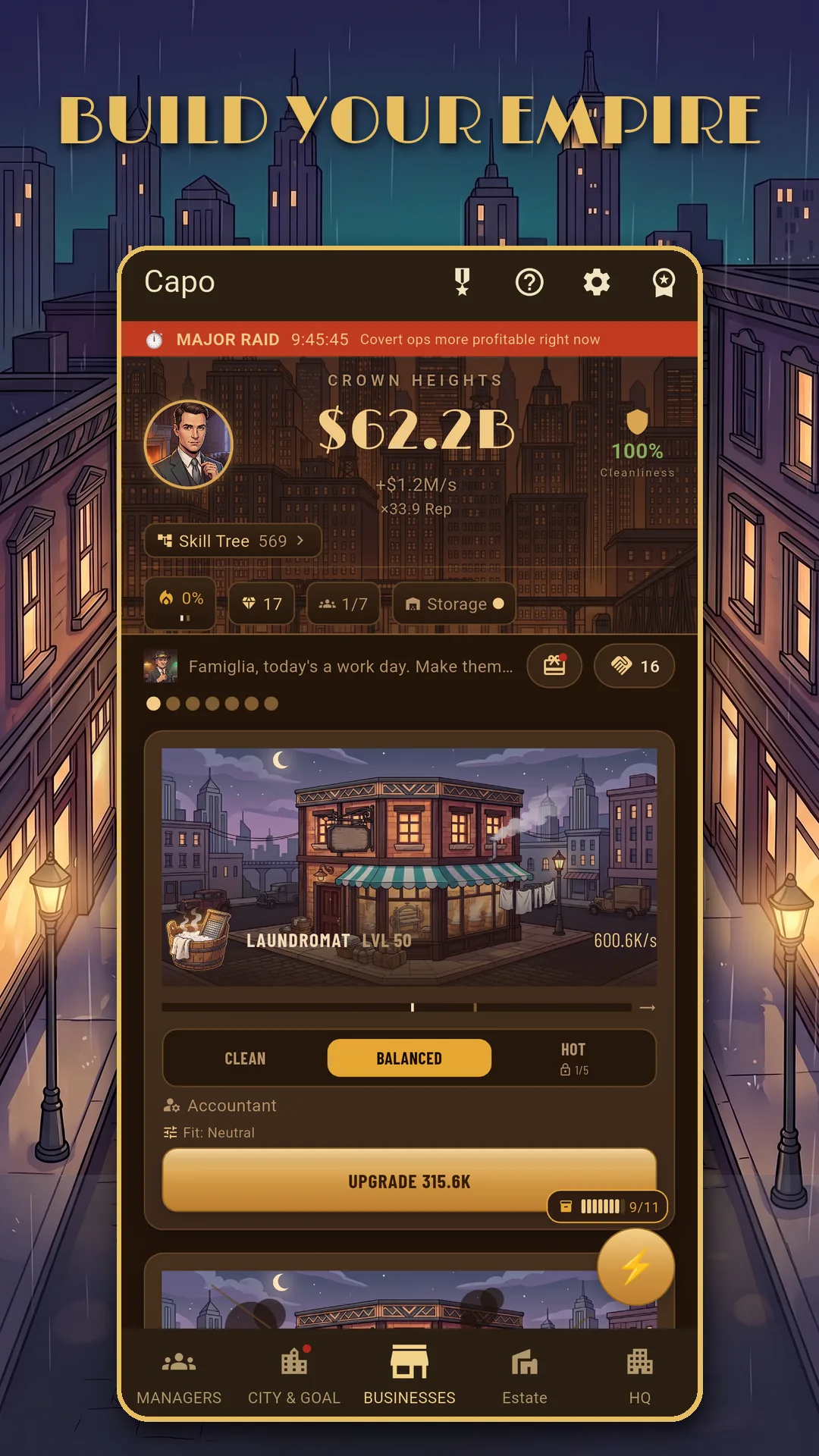
Clean out front. Dirty out back. You work the dial.

Most idle mafia games start feeling interchangeable after the first upgrade: number goes up, skin changes, that's it. Here, every single business has two faces — and you decide, for each one, which is currently winning.

The storefront

Laundromat, diner, barbershop. Legal, slow, unremarkable. Pays little — and cools down the attention on you.

The backroom

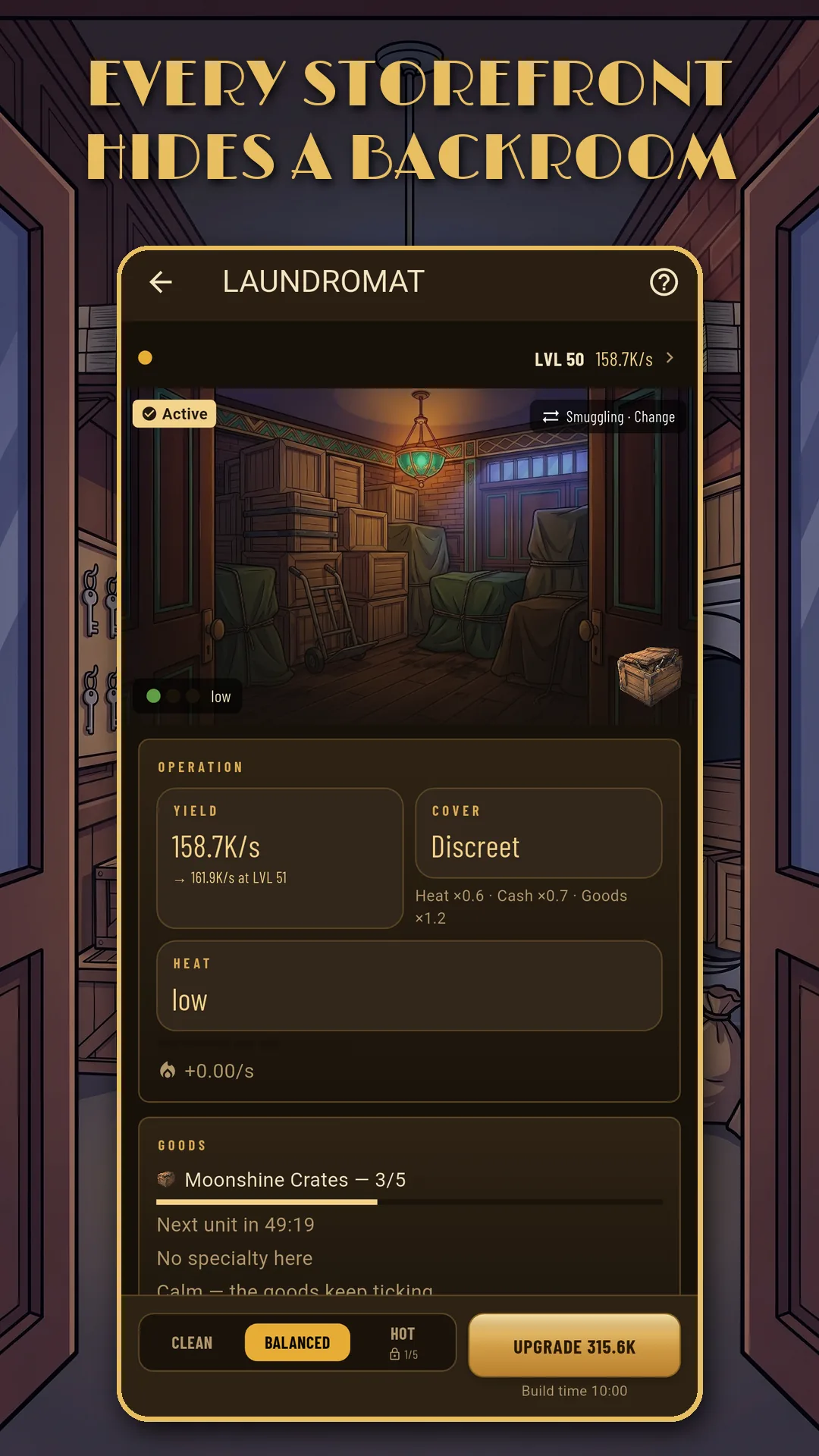
Card games, smuggling, protection. Fast money that pays a multiple — and every minute it runs, it heats you up.

The tension dial

Three settings. One decision. Constantly.

For each business you pick clean, balanced or hot. The greedier you get, the more it pays — and the faster heat climbs toward the alarm zone. Once a business sits there, the game starts rolling dice against you. Not if anymore. When.

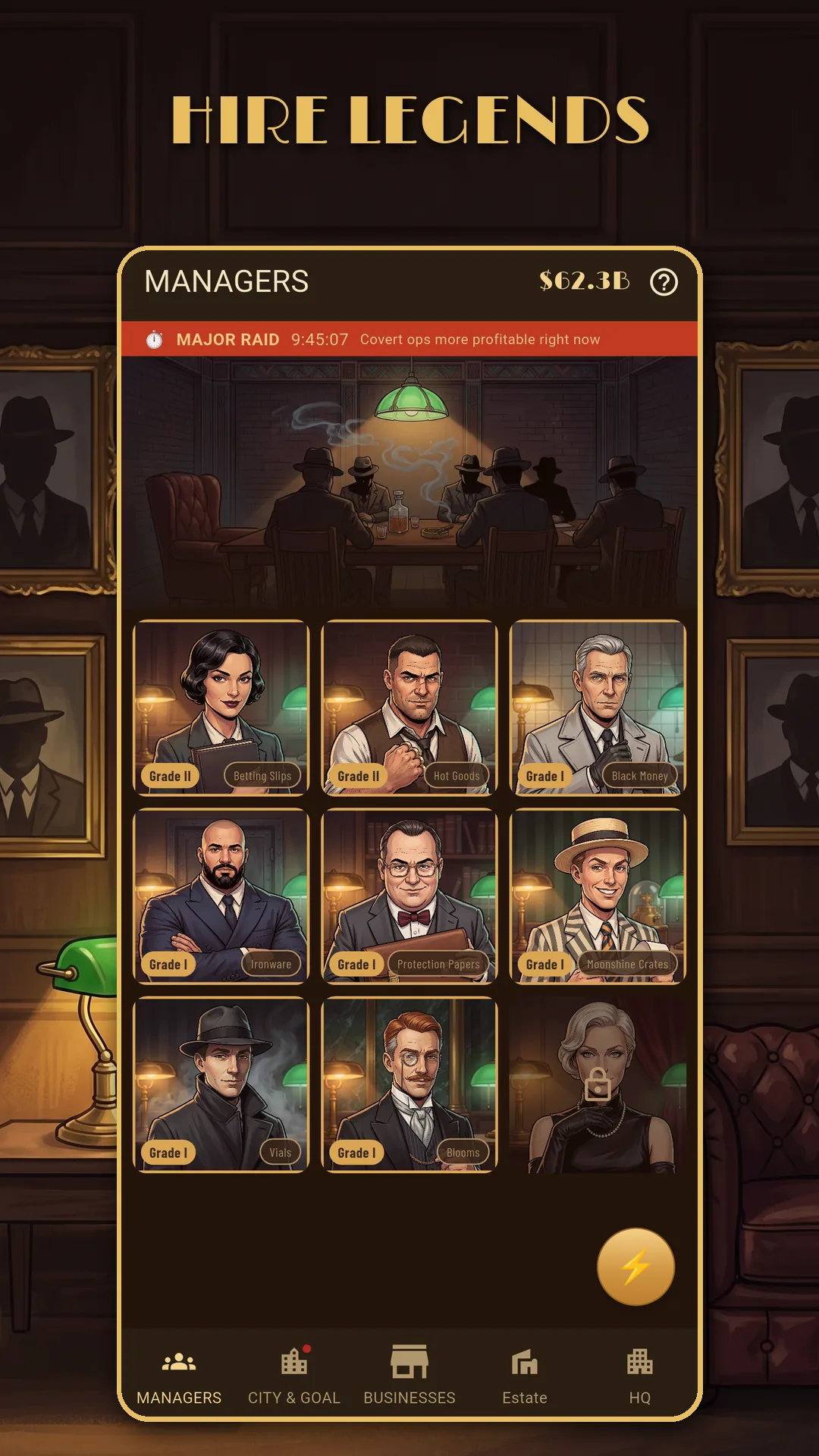
Manager overview: three unlocked characters, six still locked
Character card for Al Capone — income +40%, heat +30%, cleaning −20%
Character card for The Cleaner — cleaning +500%

Slot: 15-second silent loop — heat climbs into the alarm zone, dial pulls back at the last second. Record from the running build.

That's the game. Prose can't carry it.

Be there when it drops

There's no date yet — which means there's no date for you to remember. Pre-register, and Play will tell you when there is one.

Pre-register on Google Play

Free · no commitment

What you don't do

The stuff that makes you delete idle games.

No energy system

No bars draining. No timers kicking you out right when it gets interesting. You stop when you want to stop.

No penalty for leaving

Your empire works while you work. Heat only builds slowly offline and is capped — you never come back to a raid, no matter how long you've been gone.

Nothing breaks

If a raid lands, one business goes quiet for a while. It isn't destroyed, isn't permanently lost, and your progress stays exactly where it was.

How deep it goes

Enough game for the next few months.

The short version, for anyone who already knows they want it and is just checking there's enough in there.

Three ladders up

Legal

School principal → President

Won by building wide: many businesses, strong storefronts, a clean name. Politics as the endgame.

Criminal

Street boss → Boss of all bosses

Won by earning in the backroom. Demands you run hot — the heat is the price, not the scoreboard.

Economic

Shopkeeper → Empire

Won by simply having the most money. No glamour, no honour — just the balance sheet.

Your archetype and your ladder don't have to match. If they do, the target gets easier and the reward smaller. If they don't, it gets hard — and pays more.

Five cities, each hotter than the last

01
Ashport
Where everyone starts. Nothing's especially hot here — yet.
02
Vermillion Bay
A smuggler's harbour. Nobody here asks what crossed the docks at night.
03
Crown Heights
A restless district. High baseline tension, short fuse.
04
Port Hollow
A rougher harbour. Bigger risks, bigger takes.
05
Iron District
Hostile and hot. The last city before it all starts over.

And a sixth. It's already there, visible, locked. More on that when you get close enough.

And what crosses the docks at night

Run balanced or hot, and your backroom doesn't just produce money — it produces goods. Six kinds across three rarity tiers. They pile up while you're away, too. Full stocks unlock city milestones that permanently raise your prestige bonus. Play it safe every time, and you'll never see the rare ones.

Sound like your kind of game?

Then don't miss the launch. Play will tell you and install it automatically — nothing for you to remember.

Pre-register on Google Play

Free · no commitment

FAQ

What you're probably thinking right now.

Answered honestly — including the parts that aren't settled yet.

The deal

“A business that only makes money is a hobby. Two businesses in the same room — that's a profession.”

Laundromat out front, backroom out back — what is this?

You take over a small business in a Prohibition-era city. Out front, the storefront — laundromat, diner, barbershop — earning slow, legal money. Out back, the backroom, paying a multiple and drawing attention.

One business becomes two, two become twenty. Eventually you're standing on a street where every building is yours and every one of them has a second door.

Why isn't this just “number goes up” again?

Because here the number has a price. In most idle games more income is simply better — there's never a reason to slow down. Here there is: every dollar out of the backroom costs you quiet.

That turns tapping into a question the game re-asks you every few minutes: is what's coming in enough — or do you push? “Number goes up” becomes “manage the tension.” And that's a skill you can actually get better at.

How dark is the tone — Scorsese or Sunday night?

Sunday night, with a wink. This is a gangster fantasy, not a crime drama: art deco, sepia, fat cigars, not a drop of blood. Your people don't break knees — they “have a conversation,” and afterwards the shopkeeper pays on time.

What gets smuggled is liquor. There's a crooked card game in the back. The sheriff has a price, and it isn't in his employment contract.

The tension comes from the heat meter, not from a shock image. If you like the 1920s cliché, you're in the right place. If you want a study of organised crime, you're not.

How far you push it

“Everybody has a limit. Most people find theirs about ten seconds after they've crossed it.”

How far can I push it before the cops show up?

Further than you think. That's the trap.

Let a backroom run too hot and the business goes into alarm — clearly visible, no sucker punch. From there the game rolls against you, and the odds climb the longer you stand there. And of course, right now that business is earning more than it ever has.

You can always get out: dial it down, pay off the beat cop, put gold bars on the table. It costs you something every time. And every time, you do the maths on whether there's another ten seconds in it.

The good players live in the alarm zone. On purpose. For hours.

(And if it does land: one business, quiet for a while. That's all — nothing here ever breaks.)

What's the dumbest mistake new players make?

Everything on “hot,” because the number goes up so nicely.

It works, too — for about twenty minutes. Then half your businesses are in alarm at once, you can't bribe fast enough, and the first raid lands on exactly the one that was earning most.

The second-dumbest mistake is the overcorrection: everything on “clean,” never touch it again. Then nothing bad happens to you. Nothing else happens either.

Who am I in this city?

Your call. There are several archetypes — from the brutal one who earns big and is always being noticed, to the quiet operator who grows at half the speed and whom nobody can pin anything on.

The archetype doesn't just move numbers; it changes how the city feels. And every new run you pick a different one — same five cities, an entirely different path through them.

Can I make it as an honest man?

Yes. And it's harder.

The legal ladder isn't won by earning the most — it's won by building the widest: many businesses, strong storefronts, a reputation nothing sticks to. At the top there's no godfather. There's a president.

The catch: storefronts pay badly. You will watch someone with half your empire earn twice your money — and decide, every evening, whether your clean name is worth it.

What am I actually smuggling?

Six kinds of goods, across three rarity tiers — but only if you run balanced or hot. Play it safe, and you'll never see the rare ones.

Goods pile up while you're away, too. Full stocks unlock city milestones, and those permanently raise your prestige bonus. It's the game's second currency: money you spend, goods decide how strong you start your next life.

Can I get someone else to do this?

That's what lieutenants are for. Each one costs you something different.

The accountant keeps the books so clean nobody looks twice — earns less, sleeps better. The enforcer pulls in noticeably more, and pulls in attention too. The cleaner launders in the background without anyone noticing how much runs through. And the muscle stands at the door: raids bounce off them, but they want paying every Friday regardless of how business went.

Put them to work and your empire runs itself. Put them to work properly — the accountant on your hottest business, the muscle where you get greedy — and it runs several times faster.

What happens when a city gets too hot for me?

Then you disappear. Overnight. With everything you learned and none of what you built.

Every city has a point where your name has come up too often: the storefronts too well known, the police chief too expensive, every paper knows your face. From there nothing grows. So you leave behind the laundromat you bought in hour one, get on a train, and in the morning you're standing in a city that doesn't know you yet.

The only thing that comes with you is your reputation — and it's worth more than the money. In Ashport you started at zero. In Vermillion Bay, doors open before you knock.

Five cities, each hotter than the last. And once you've left the fifth behind, you start over — as somebody else.

(Idle veterans know this as prestige.)

The catch

“Everybody asks about the price first. The price is never the problem.”

What does this cost me?

Nothing. No purchase, no paywall, no login — you hit install and a minute later you're behind the counter of your first laundromat.

It's paid for with ads you go and get, not ads that jump you: watch a video, double your offline earnings. Or call off a raid at the last second.

One exception, named honestly: when you change cities there's an ad break you can't skip. That one can be removed with a purchase — the voluntary videos stay, because those actually give you something.

Never watch a single video and you still play the whole game. You just get rich slower — the way a clean boss gets rich slower.

Can someone buy their way past me?

There are optional purchases: a hard currency for boosters and extras, cosmetic characters, and the offer against the city-change ad mentioned above.

What there isn't: a purchase that plays the game for you. The tension dial isn't for sale. Neither is the decision about how far you go. Pay, and you move faster — get good, and you go further.

Also: there's no real gambling. The in-game “casino” is an abstract income source with no slot mechanics, no stakes and no real money.

Can I play this fully on autopilot?

Yes. Assign your lieutenants, set everything to balanced, and the game runs without you. For a lot of people that's exactly the point: check in, collect, get on with your day.

But you'll leave money on the table. Managing actively and timing it yourself pulls noticeably more out of every business. Both ways work — they just build very different empires.

What's my empire doing while I'm at work?

Earning. Your businesses keep running, your goods keep piling up, and both are waiting when you get back.

Heat only builds slowly offline and is capped — you never come back to a raid, no matter how long you were gone. Offline progress never turns into a penalty here. If you want, double your offline earnings with a video. You never have to.

Why would I come back tomorrow?

Because three small goals are waiting each day, and they push you somewhere you wouldn't otherwise go — one of them explicitly asks you to hold your heat high without it blowing up. Plus a daily bonus and achievements that build on each other.

(These reward systems are still being built — planned and partly done, but not final yet.)

When can I play it?

“Patience is the only thing in this business that doesn't cost anything.”

How far along is it — and when can I play it?

The core is built and running: the economy, the storefront/backroom system, the five cities, relocating, the career ladders, the goods. That's built, tested and playable.

What's left are the unglamorous final steps before a launch — the privacy and ad-consent flow, and the fine-tuning on daily rewards. That's why there's no fixed date, and why you won't get promised one here that then doesn't hold.

What you can do instead: pre-register. Then there's nothing for you to remember — Play tells you when it's ready and installs it for you if you want.

Pre-register on Google Play

Free · no commitment

What does it run on?

Android first, via Google Play. Other platforms aren't ruled out, but they aren't confirmed — and until they are, nothing else will be claimed here.

Do I need an account? And what if I change phones?

No, you can start straight away with no login. Your save lives on your device — it doesn't depend on a server, and nobody can switch it off on you.

For changing phones there's an optional cloud save you can link if you want. It's not required.

Why is it called something else in the store?

On Google Play it will most likely be called Capo: Idle Crime Tycoon — that's the name you'll find it under there. “Clean Money” is the name it was built under, and the one we keep here. Same game, two names, no trick.

Out of questions?

Then there's only one left: how hot do you let it run?

Pre-register on Google Play

Free · no commitment · Play auto-installs it at launch

No date.
Don't miss it.
Pre-register